Game Art Runs on Iteration. Paid Generators Charge for Every Try.
This week one of my game characters came out of a 3D generator with four ears.
Two were where ears go. The other two sat just behind them, like a spare set. By the numbers the model looked fine: one solid piece, no holes, and the level of detail I had asked for. It took thirteen more tries on that one head to find out what was going on, and I still only half know.
If I had been paying for each try, I would have stopped after two or three and fixed the ears by hand. This article is about that difference: the experiment you run, and the one you talk yourself out of.
Game art is trial and error, and paying per try changes what you try
Nobody gets a game character right the first time. You make a version, look at it, change something and make another. Then the design changes and you do it all again. A tool that charges for every try is charging for the main thing you do.
Each try looks cheap, and I want to be fair about that. On Tripo, the paid service I have been using, one whole character costs me 130 credits. Tripo’s published rate for developers is one cent a credit, so call it $1.30. If that were the whole story, I would not be writing this.
Four things make it add up.
Working in pieces costs much more. The first time I made a character as seven separate pieces instead of one, it cost 1,000 credits. That is about 7.7 times the price of the whole character, and the whole character looked better. It was good to learn once. It is not something you try five different ways on a Tuesday.
The real cost comes after. A generated character is not ready for a game. It has to be tidied up and given a skeleton so it can move. Going by the timestamps on my files, that took 28 to 105 minutes per character, usually about an hour. Every extra try you want to judge properly brings some of that hour with it.
You cannot see inside. When a paid service gives you four ears, all you get is the finished model. You cannot look at the steps in between, change how your pictures are fed in, or keep everything else the same while you change one thing. You can pay again and hope.
So you stop asking. This one never shows up on a bill. In August I wrote that what my own hardware buys me is “a bill that never meters my curiosity.” This article is that sentence with numbers on it.
What I got by running it on my own machine
The setup is simple. I own a small AI computer, an NVIDIA DGX Spark. On it I run Pixal3D, a free model that turns pictures into 3D and is licensed for commercial use, through a free program called ComfyUI. I give it four drawings of a character: front, back, left and right. It gives back a 3D model in colour. An AI assistant ran the jobs, suggested the tests and kept the records. I supplied the drawings, approved each round and judged the results.
It is fast. Each new version of a whole character took about 75 seconds. Eight versions took under ten minutes.
The models are tidier. All eight came out as one solid piece with no gaps. The paid service’s model of the same character came in 37 separate pieces, with 2,643 edges left open where the surface should have been sealed.
The faces are worse. All eight had a poor face, so it was not bad luck. The paid service’s face was clearly better.
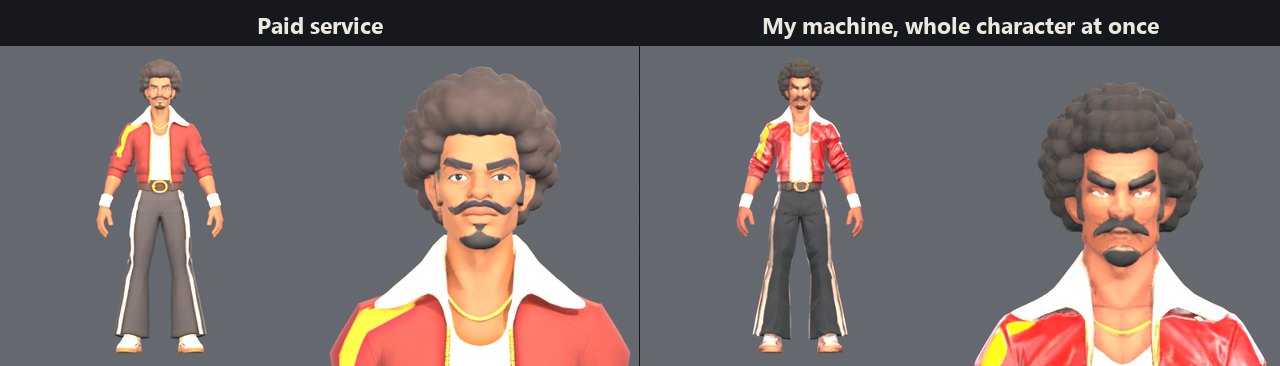
Because tries were free, the next step was simply something to try. I made the head on its own, from close-up drawings where the head fills the picture. Three out of three came back with a proper face, in five to six minutes each. The model had never been bad at faces. In a picture of the whole body, the face is a small part of the picture, and the model can only build what it can see.
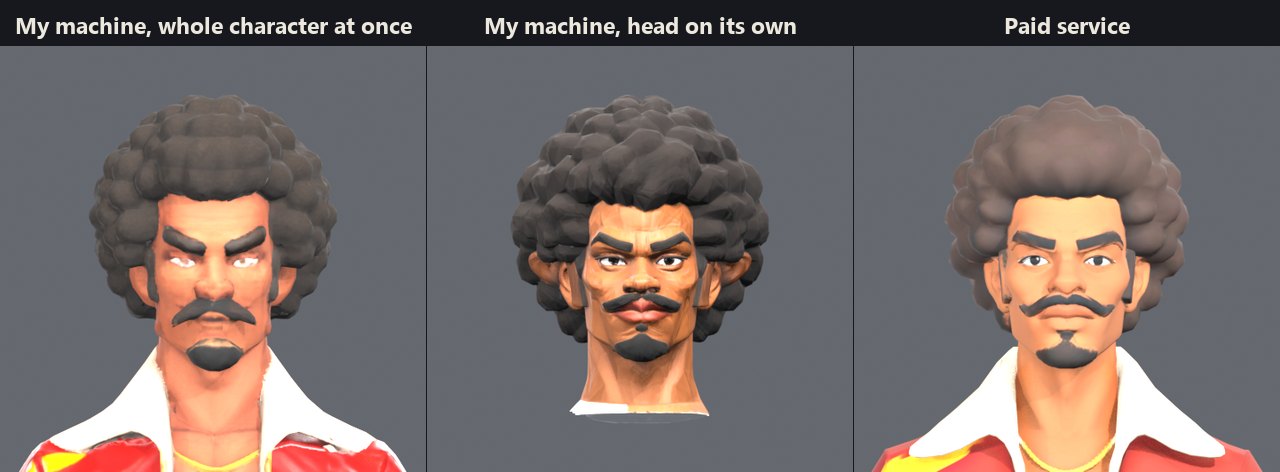
So I went back to the idea that had cost me 1,000 credits and lost: build the character in pieces. Head, body, jacket, tank top, trousers, trainers, wristband and necklace, each from its own four drawings. All eight took about 32 and a half minutes.
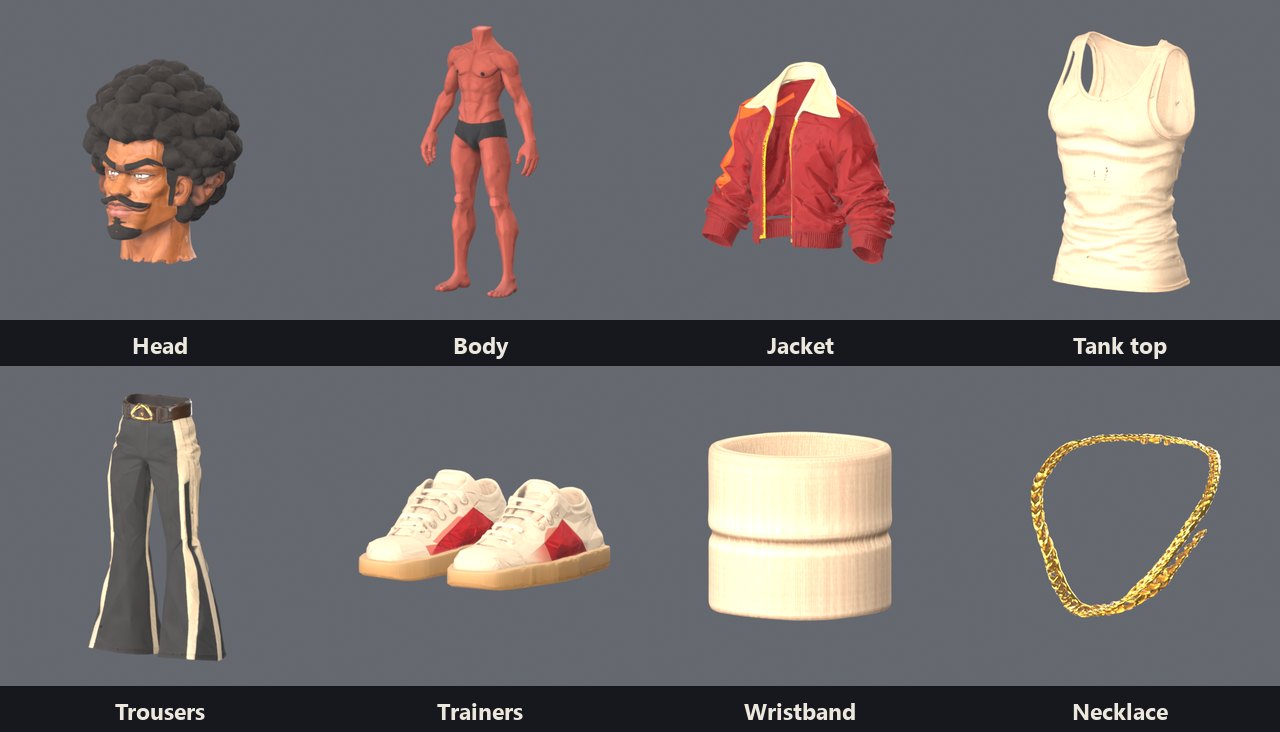
It half worked, which is the honest result.
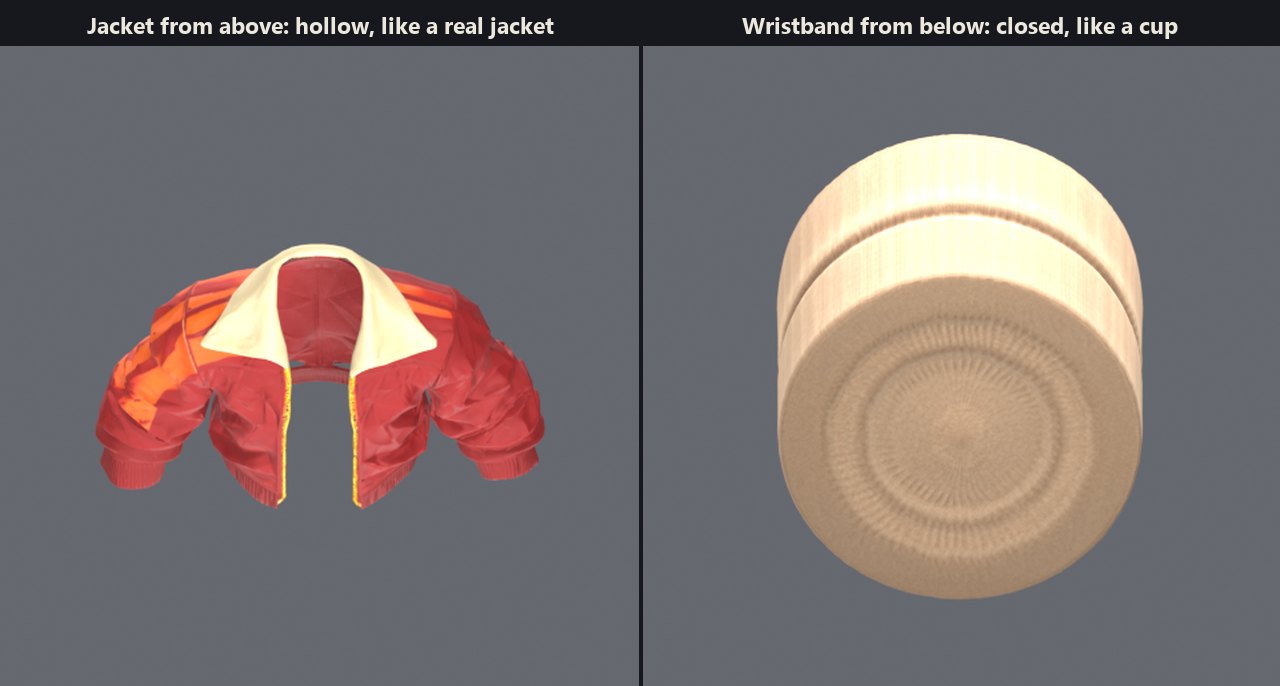
The clothes came out as real clothes. The jacket is hollow, with openings at the neck, waist and wrists. When you make a whole character at once, you get one solid lump with a jacket painted on. I had a second AI assistant, one that had not made the models, check them. It cut them into slices and confirmed the jacket really is hollow.
The small items failed. The wristband came out as a cup, closed at the bottom. The necklace was a lumpy strip with a stray bit hanging off. The body’s skin was redder than the head’s. And the head had four ears.
The four ears
I made the head thirteen more times, five to six minutes each, changing one thing at a time. Here is what I learned.
The extra ears were there in the very first shape the model produces, before any of the tidy-up steps. So the tidy-up steps were not to blame.
The model’s instructions say the character should be the same size in all four drawings. When I did exactly that, the head grew a second pair of ears five times out of five. When I made two of the four drawings about 4% smaller, I got one pair of ears five times out of seven. I do not know why. I had one good suspect: the front and back drawings disagree about where the ears are, by about 23%. I measured it, tested it, and it was not the cause.
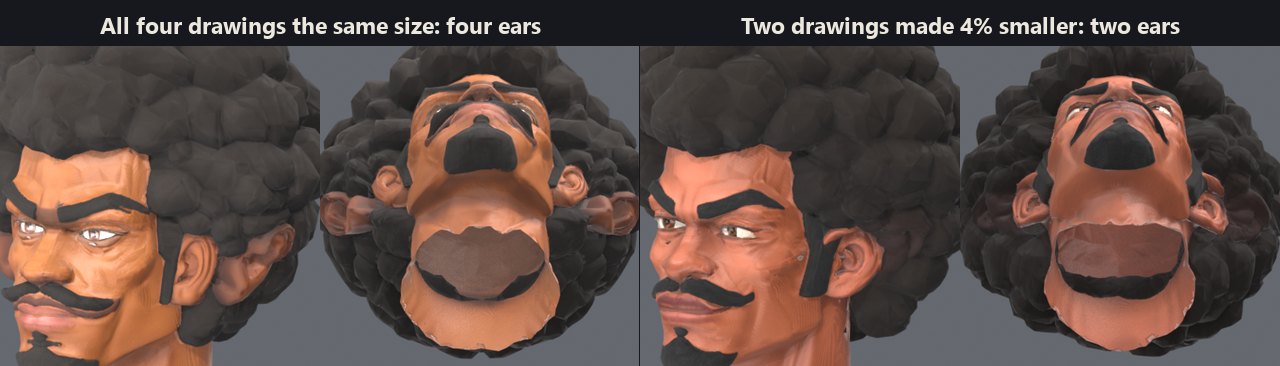
The uncomfortable part is how I found the 4%. The good head from earlier in the day had been good partly by accident. The step that cuts the character out of its background had left a pale patch under the neck, and the model turned that patch into a solid base. When I ran that same step on the new drawings to compare, it left the patch again, and the patch had quietly made two of the drawings smaller. My cleaner drawings removed the mistake, and with it the thing that had been helping.
By the end of the day I had run 21 jobs in about 106 minutes of computer time. Not one of them was a spending decision.
What it did not fix
A character made all at once is still one solid lump. The eyes and the inside of the mouth are not separate. The paid service still makes the better face first time. Nothing here has been fitted together or given a skeleton, and every piece comes out at its own size. The drawings for each piece came from an online image generator, a step I have not moved to my own machine yet.
Free to download is also not the same as free to sell with. Several free 3D tools depend on a piece that is only allowed for research, not for products. My advice from August still stands: check the licence on every piece before you ship.
And free per try is not free. The computer that runs all this cost $3,999.
A way of working, not a recipe
Every game needs a slightly different way of making its art, so I cannot give you steps. What carries over is a handful of decisions.
Experiment where tries are free. Pay when the paid result is clearly better and you already know what you want.
Give the important parts the most room. Whatever players will look at most should fill the picture you start from.
Keep each step replaceable. Drawings, 3D shape, tidy-up, colour, skeleton, getting it into the game. The tools will change. The steps will not.
Have someone look, not just count. By the numbers, the eight pieces looked fine: all at the level of detail I asked for, seven of them one solid piece with no gaps. One of those seven was a cup and one had four ears. A reviewer who had not made them found both.
Expect to pick from several. Some steps are a roll of the dice. Make a few and have a person choose. That only makes sense when the rolls cost nothing.
Believe your own tests over the instructions. Doing what the instructions said gave me the worse head.
Do not treat every piece the same. The wristband got the same level of detail as the whole body and took longer to make than any other piece. I could have made it by hand faster.
Splitting a character up moves the work. It does not remove it. Separate pieces are easier to fix one at a time. They also have to be sized, fitted and colour-matched.
Two things are still unsolved, and I would rather say so. I have not managed to give a generated character a face that can move, or a skeleton it shares with other characters. One attempt kept the likeness, but the facial expressions did not work. And I still cannot tell you why shrinking two drawings by 4% helps.
None of this makes the paid services bad. Their faces beat mine today. It makes them the wrong place to do your thinking. Think where it is free, then pay for the result you already know you want.
Where does paying per try change what you are willing to try? I would like to hear where others have drawn that line.