Agents Write the Code Now. I Write What a Designer Gets to Touch.
In my game, the jab that opens the hero’s combo lasts a third of a second. Games count time in frames, 60 to a second, so that jab is 20 frames: 5 to wind up, 3 when it can land, and 12 to recover.
I did not write the code that makes that punch work. AI agents did. What I wrote was everything around it: who gets to change those numbers, how they can see what a change does, what the tool should explain without being asked, and what no automated process is ever allowed to undo.
That is the change I want to describe. When agents write the code, a developer’s most important work moves somewhere else, to what I call the designer surface: everything a person can see, change and trust while tuning a game, without reading any code. And because agents build that too, my job is not building it. It is describing it clearly enough that an agent can.
The part agents cannot do
In August I wrote that agents sped up about 40% of my work, the systems and the structure, and did almost nothing for the other 60%: judgment, taste, and how a product feels.
In a fighting game, “feel” is not vague. It is numbers. How quickly a punch comes out. How far it reaches. How long you have to follow it with the next attack. You find the right numbers by playing, changing one, and playing again, over and over. A person has to do that.
So that 60% needs a place to happen. If agents write the code, someone has to decide what that place looks like.
The game is PRINT IT!, which began as my four-day entry to the 2026 Epic AI MegaJam. When I kept working on it after the jam, I wrote down the goal for the agents: the agents do the building, and a designer can fine-tune easily. That turned into three layers:
- The code decides how things work, and starts every number at a plain default. The agents write it.
- The game’s content lives in settings files the agents create. Attacks, characters, sets.
- A person adjusts those same files by hand, in Unreal’s own editors. There is nothing the agents cannot build, and nothing a designer cannot tune.
The rest of this article looks at one of those editors.
A look at one tool: the move editor
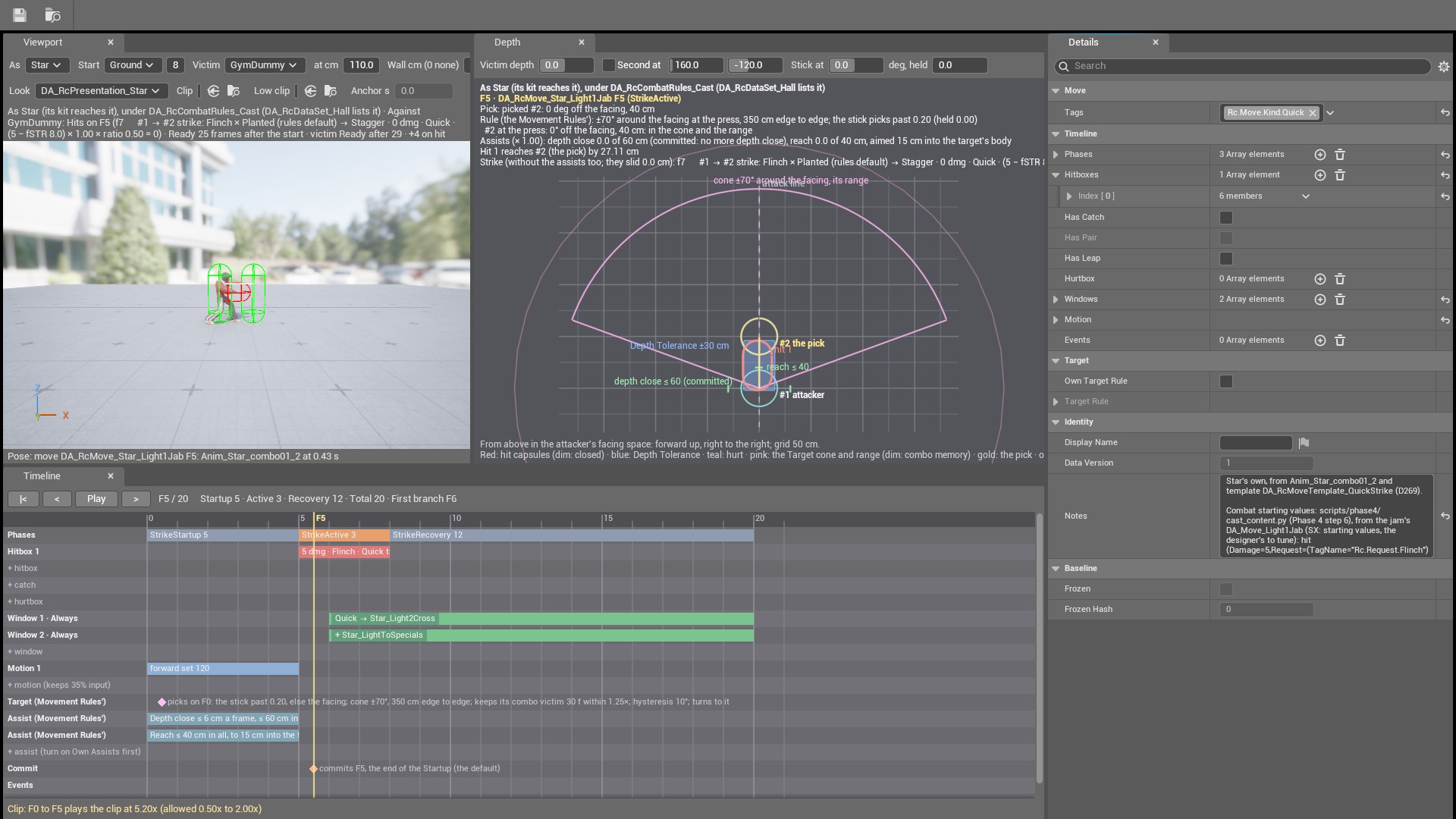
Every punch, kick, throw and dodge in the game is a “move”: a file of settings, not code. There are 65 of them across 8 fighters. Open one and you see it four ways at once, all paused on the same moment.
The row along the bottom is where the choices about what to show a person become visible. Most of it can be dragged with the mouse instead of typed: how long the wind-up lasts, when the punch can land, the invisible shapes that decide whether it hits, the moments when the player can chain into the next attack, how far the fighter steps forward, and the point after which the player cannot back out. Everything is measured in frames, centimetres and degrees, because those are what a person thinks in when a punch feels slow or short.
Some settings are shared by every fighter, not owned by this one move. Try to drag one and the editor refuses, tells you why, and names the switch that gives this move its own.
Even the notes on the punch, written by the agent that made it, say where its numbers came from: the punch in the jam version of the game, kept as starting values, “the designer’s to tune”.
None of that happens on its own. Left alone, an agent shows you what the code has: lists of settings with names only a programmer would pick. What fixes that is not a coding instruction. It is a description of the person: what they are trying to get right, and what they will reach for when it feels wrong.
Every tool has to say why
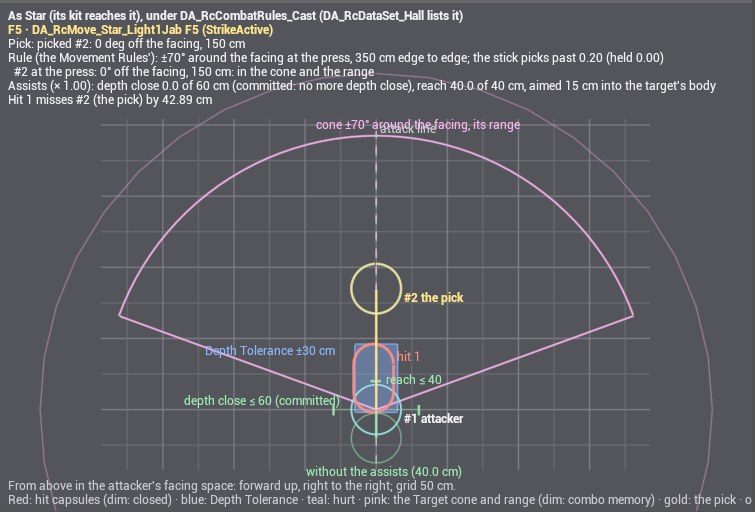
The rule I repeat to the agents most is four words long: every tool answers why.
A punch that misses is the most common thing a designer sees, and “it missed” does not help. Here the target is 220 cm away. The editor says the punch found its target, that the fighter was automatically stepped forward the full 40 cm allowed, and that the punch still misses by 42.89 cm. It also says the punch cannot reach a target that far away at all. A designer can fix that without touching code: move the target closer, make the punch reach further, or allow a bigger step.
The same kind of explanation once caught a bug that no automated test had looked for. Last week it showed a test punch missing by 0.000000000000014 of a centimetre, a gap far smaller than an atom. The automatic step moved the attacker until the two bodies exactly touched, so whether the punch landed came down to a rounding error. The fix was to aim 15 cm into the body instead. The tool explained itself, and the number was ridiculous enough to notice.
Warn, do not decide
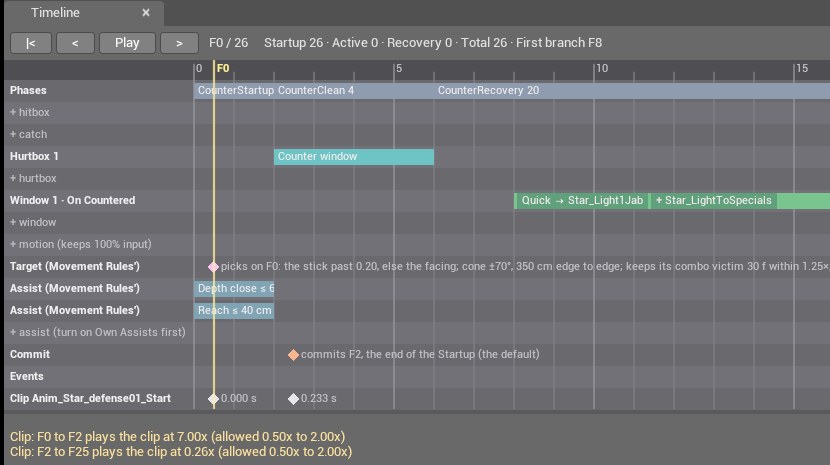
The counter is a newer move. Press the button, and for four frames you can catch an incoming hit and open up a follow-up attack. The agents built it from a template, then needed an animation for it. The animation pack I am using has no parry, so they used the hero’s block.
The editor warns that the block now plays at seven times its normal speed for two frames and at about a quarter speed for the rest. It does not fix it. Picking a different animation is a matter of taste, and taste is my call, so the agent that set up the move left the warning in place and noted the decision for me. The punch in the first picture has the same kind of warning: its animation plays at more than five times its normal speed.
That restraint has to be spelled out, because an agent’s instinct is to help. Two things went wrong before I spelled it out.
The checks locked in my numbers. The first automated checks compared the game’s settings with what the setup scripts had first written. Adjust a sound, or how a character reacts to a hit, and a check would fail, as if tuning were damage. Now the checks only make sure everything is filled in and works. They never check that a number is still what it was.
A setup script overwrote my numbers. Two days later I asked the agents to confirm they were still building something a designer could comfortably work in. Their review found a setup script that, when it ran again, put its own starting values back over anything that had changed. Now a script only fills in a setting nobody has touched. Anything else it leaves alone, and it notes that it did.
What I actually tell the agents
These instructions are a few lines in a file every agent reads at the start of every session. In plain words:
- The code decides how things work, never what the content is. A punch’s damage never lives in the code.
- Anything a designer uses gets a version they can open without code.
- Files point to each other directly, never by typed-out names, so renaming one cannot quietly break another.
- A script only fills in a setting nobody has changed.
- Every tool answers why.
- Checks make sure the content works, never that a number stays the same.
- Design decisions are mine. Give me options, with a recommendation first.
- How it feels is up to the person tuning it. Explain what a number does and suggest values. Never quietly change what they have set.
- Test what a mechanic really does, with the real characters. Passing tests prove the code runs, not that the punch feels right.
None of these are about how to write code. They describe a person: what they reach for, what they need explained, and what they need to be able to trust. That is the work that is left, and it turns out to be most of what makes the tools good.
What still is not solved
While taking these screenshots, I found the move editor had quietly lost something. On November 16 the agents taught it to show the hero’s punch against the game’s other fighters. That same evening, they added a list of fighters for a rehearsal room. It includes the hero but no opponents, and the editor now finds that list first when it works out who a move belongs to. The only target left is the training dummy. That is why every picture here shows the punch hitting a dummy for zero damage, with the sum beside it explaining why.
Nothing caught it. The automated tests check that part of the editor with test characters, and none of them asks what a designer can actually pick for the real cast. The tools need checks of their own, and I had not asked for any.
The tools also cost more than they look. For the fighting alone, the editor tools are 24,498 lines of code. The code that runs the fighting is 18,611. Agents wrote both, which is the only reason one person can afford to build more tool than game.
And so far, the only designer is me. Nobody else has tuned a move in this editor yet. Until someone does, I know the tools work for the person who described them. That is not the same as knowing they work.
The job now
The code still exists, and it still has to be right. But agents write it, and the decisions that used to be buried in it now have to be said out loud: who can change this number, how it is measured, what the tool says about it, and what can never change it back. Most of what I write for agents now is not about code. It is about a person.
If agents write your code, what is on your list of things a person must always be able to change?